
TEAM's FY2027 Final Rule Landed: Changes Impact PY1 and Future Years

Published by APM Connect | August 2026
The FY2027 IPPS proposed changes (CMS-1849-F) are now final, and modifications include changes starting as early as October 1, 2026. For hospitals in the Transforming Episode Accountability Model (TEAM), CMS finalized nearly every proposal without modification.
We've outlined what's changing and what your team should line up before the rule takes effect.
The spinal fusion episode category is expanding
CMS is adding three newly created MS-DRGs (523, 524, and 525) to the TEAM spinal fusion episode category effective October 1, 2026. Any of these DRGs will initiate a spinal fusion anchor hospitalization, in addition to the existing spinal fusion DRGs.
The operational issue will continue to be timing. As CMS acknowledges, hospitals often won't know a Medicare patient’s final DRG at the time of discharge. The rule's guidance is direct: track underlying diagnosis and procedure codes proactively to identify potential episode triggers and begin care coordination for every potential TEAM beneficiary rather than waiting for the final DRG to post. Easier said than done.
Target pricing gets more precise and shifts mid-year
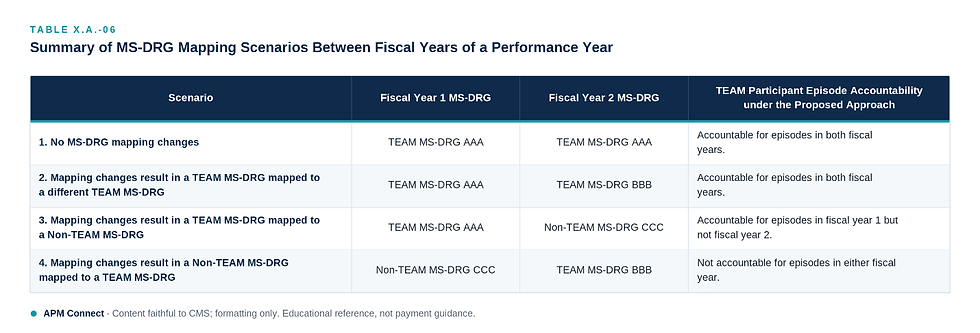
Two pricing refinements were finalized. Beginning in performance year 1, CMS will apply an Ambulatory Payment Classification (APC) update factor and an MS-DRG update factor to final target-price calculations (§ 512.505, § 512.540(b)(7), § 512.545, § 512.550). Both adjustments align your target price and reconciliation amount with the payment weights in effect during the performance year, rather than the weights from the year the baseline was built. CMS finalizes coding changes in the annual payment rules with MS-DRG aligned to the fiscal year (FY) and HCPCS-APC aligned with the calendar year (CY). This methodology accounts for the changes in IPPS and OPPS/ASC rules that are released during the performance year and alter definition and weight changes for MS-DRGs and HCPCS-APCs. TEAM participants will now receive not only the preliminary target price but an updated target price prior to the final target reconciliation that accounts for the payment changes.
Example Preliminary Target Prices Use
HCPCS- APC mappings and weights from Jan – Dec 2025
MS-DRG definitions and weights from Oct 2025 – Sept 2026
Update Factors in Advance of Final Target include
HCPCS-APC Jan – Dec 2026
MS_DRG – Anchor end dates in Q4, update multiplier, normalization factor, trend factor
This is a real change, and it lands mid-PY1. The APC update factor can push target prices down if relative weights fall between calendar years. This information doesn't arrive until late in the year, making operational adjustments harder. CMS's counterweights are timing and risk: the factors are shared before final target prices are set, and because most participants elected Track 1 (no downside risk) for PY1, the sting of any downward adjustment is limited this year.
Included below are CMS reference tables that depict the final changes.


If you need help determining the impact to your target price, APM Connect can guide you to some great resources HERE
Prospective Normalization Factor Construction
Within the benchmark and target price calculations, the prospective normalization factor ensures the average benchmark price after risk adjustment does not exceed the average benchmark price prior to risk adjustment. Risk adjustment raises expected spending for sicker-than-average patients and lowers it for healthier ones. The normalization factor recenters the risk-adjusted benchmark prices so that, on average, they equal the total non-risk-adjusted benchmark price. It ensures that the risk model redistributes dollars across episodes. The factor is applied through a risk adjustment multiplier that converts each episode's patient risk into a price adjustment.
Looking ahead to PY2, CMS finalized a new way to build the prospective normalization factor calculated at the episode type and region level using all baseline period episodes, instead of calculating at the national level using the most recent year. CMS's analysis found this improves predictive accuracy and smooths short-term fluctuations.
Where TEAM ends and CJR-X begins
The rule also finalizes CJR-X, a separate mandatory lower-extremity joint replacement model, and draws a clean line between the two. TEAM tests a 30-day post-discharge episode; CJR-X tests 90 days. TEAM participants are excluded from CJR-X through 2030.
Under the finalized attribution rule at § 512.537(b)(4), if a beneficiary already in a CJR-X 90-day episode has a procedure at your hospital that would otherwise start a TEAM episode, it will not initiate a TEAM episode. That spending flows into the CJR-X episode instead, although it still counts in TEAM target-price construction which relies on average episode spending across regions.
Quality Timelines and Composite Quality Score (CQS) Baseline Period
From a quality perspective, the Hospital Harm measure performance periods don't begin until January 1, 2027, and the measures don't apply until PY2. This gives you some time to identify targets and plan improvement. There's no TEAM-specific mandate to report them, and any hospital with an incomplete raw measure score receives a scaled score of 50. These measures include Hospital Harm – Falls with Injury and Hospital Harm – Postoperative Respiratory Failure. The outlined new measurement periods are below.

CMS also finalized the shift to sliding historical Composite Quality Score (CQS) baseline periods running July through June, and aligning baseline periods with the CMS hospital reporting program timeframes for the Hybrid HWR, CMS PSI-90, THA/TKA PRO-PM, and the ISCMR measures. The sliding baseline would be calculated using a rolling window of historical performance updated annually, rather than remaining fixed. The sliding baseline keeps performance expectations moving rather than static, forcing year-over-year improvement into the quality measures. Below are the finalized baseline periods.

One to watch: physician-owned hospitals
Finally, CMS signaled that it intends to propose a pathway for physician-owned hospitals located outside mandatory markets to opt into TEAM in future rulemaking.
What to do before October 1
Map the new spinal fusion DRGs (523/524/525) into your TEAM trigger-identification workflow, keyed to diagnosis and procedure codes rather than the final DRG.
Brief your finance and reconciliation team on the APC and MS-DRG update factors. Understand how these may impact your financial projections.
Put the January 1, 2027 Hospital Harm measurement start date on your quality calendar and choose improvement targets now.
At APM Connect, we're translating the final rule into member-ready checklists and workflows so your team can move from reading the regulation to running it. Hospitals can take advantage of complimentary membership to attend webinars and access our resource library.


Comments