
What National Claims Data Says About CJR-X Before It Starts

Published by APM Connect on 11/9/2026
CJR-X does not begin until 2028, and hospitals keep asking the same question: how are we going to do in a model we have no data for yet? Session 3 of the Downside Risk Bootcamp answered it the only way it can be answered, by running national Medicare fee-for-service claims from 2023 through 2025 against the CJR-X rules and seeing what comes out. The session walked the national picture first, then took one blinded hospital apart line by line.
WHAT WE COVERED
Nearly all of CJR-X lives in one pricing group. Of four pricing groups, the one combining DRG 470 with the two hospital outpatient codes holds about 88 percent of national episodes. Hip fractures account for roughly another 8 percent. The remaining two groups are small enough that most hospitals can treat them as rounding.
Your inpatient and outpatient mix is a pricing problem, not just a clinical one. Because inpatient and outpatient cases are priced into a single target, hospitals doing more of these cases inpatient are more likely to lose money. Nationally the average inpatient episode cost about 32,900 dollars against a target around 23,700. The presenters were careful to say this is a feature of how the model prices, not by itself an argument to move everything outpatient.
The money is not in the surgery. Comparing the 10th percentile hospital to the 90th, the facility payment differs by a few hundred dollars. Post-acute care differs by roughly 9,000. Everything that decides CJR-X performance happens after the anchor procedure.
Small volume means your result is partly noise. Among hospitals with 11 to 50 episodes, about a third flipped between beating and missing the target from one year to the next. Larger hospitals landed consistently on one side. If you are a low-volume hospital, one good year is not evidence of a working program.
The case study made the method concrete. One blinded hospital looked modestly over target on the big pricing group, driven almost entirely by post-acute spend while its facility payments, physician services and readmissions all ran below target. Its small hip fracture cohort was the real problem, running far above target and getting worse year over year, with risk scores in line with its region, so coding was not the explanation. Projected forward, that hospital would owe CMS a meaningful sum, and most of it traced to one low-volume cohort nobody would have looked at first.
The full session, including the walkthrough of how to triage a hospital's own data and the discussion of the telehealth and SNF waivers, and the presentation slides are available here to APM Connect members here:
(members only)
RELATED RESOURCES
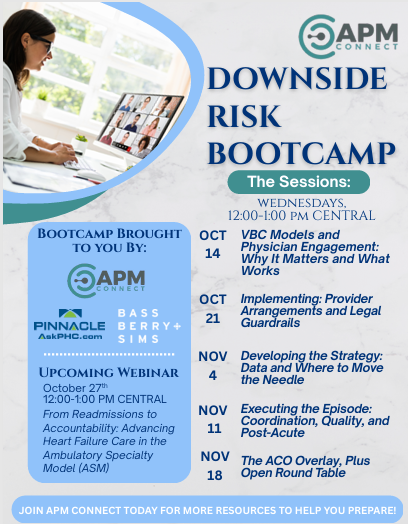
JOIN US FOR SESSION 4
Session 4 is next Wednesday at noon on care management and controlling post-acute costs, which is exactly where this session's data points.
One registration covers all five sessions of the bootcamp. [LINK: bootcamp registration]


Comments